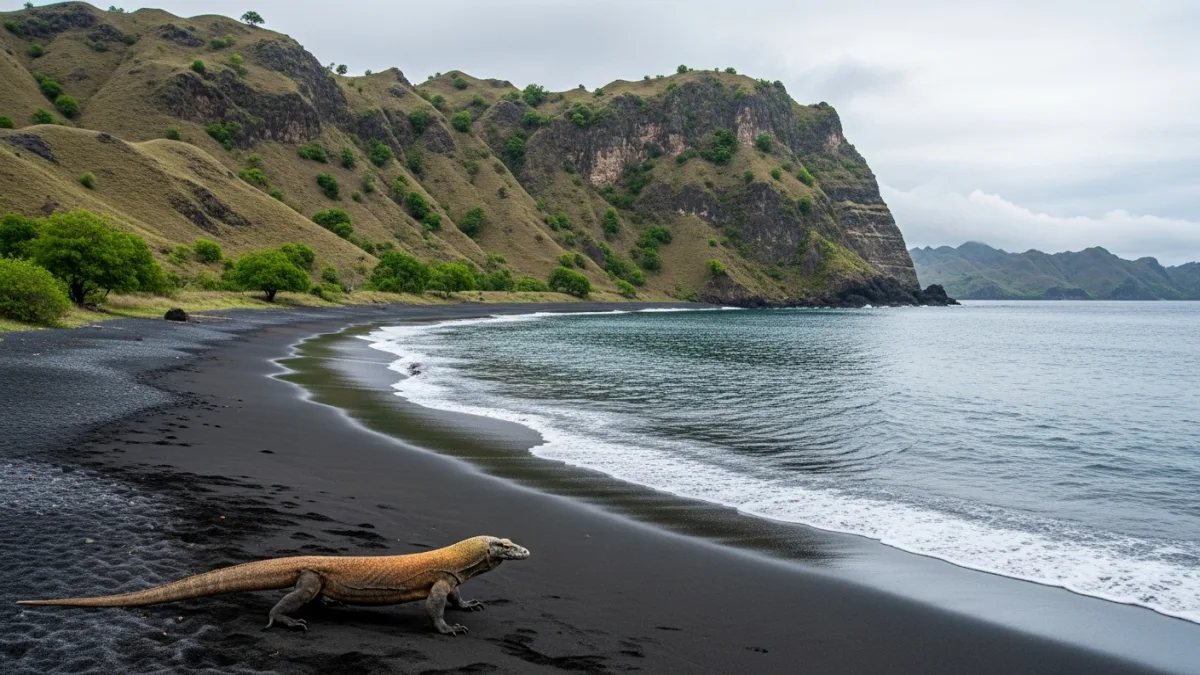
Nusa Kode, also called Gili Dasami, is one of the four islands inside Komodo National Park where wild Komodo dragons live, and it shelters Horseshoe Bay in the park’s far south — a deep, cliff-walled anchorage where dragons patrol the beach, the water runs cooler at roughly 22C, and reefs such as Cannibal Rock and Yellow Wall rank among the richest in the park.
Updated July 2026
Most visitors to Komodo National Park see the central corridor: Padar Island, Pink Beach, Manta Point, Loh Liang on Komodo Island, Loh Buaya on Rinca Island. That corridor is magnificent, and it fills our 3D2N sailings. But there is a fourth dragon island far to the south that almost nobody reaches, and it is the single most memorable anchorage we offer. Nusa Kode sits at the bottom of the park, curled around a bay shaped like a horseshoe, backed by grey volcanic cliffs and dry forest. Dragons walk the tideline there. You watch them from the deck of your own boat, at anchor, with no other guests and often no other vessel in sight.
We are the operator — komododragontour.com is run by Komodo Luxury, based in Labuan Bajo since 2015 — so this page is written from the wheelhouse rather than from a brochure. Below is exactly what Nusa Kode and Horseshoe Bay are, why they stay so wild, which of our itineraries reach them, and what the sailing legs honestly involve.
Nusa Kode: the fourth dragon island
Inside Komodo National Park, wild Varanus komodoensis lives on four islands: Komodo Island, Rinca Island, Gili Motang and Nusa Kode. Nusa Kode is the southernmost of the group and lies off the southern flank of Rinca. Wild dragons also live on the mainland of Flores — around Wae Wuul, for instance — which sits outside the park boundary, and that is why you sometimes see “five islands” quoted online.
The two names cause confusion for travellers planning a trip, so it is worth saying plainly: Nusa Kode and Gili Dasami are the same island. Charts, dive guides and older park literature use both.
| Island | Approximate population | How our guests see dragons there |
|---|---|---|
| Komodo Island (Loh Liang) | ~1,700 | Ranger-guided trekking |
| Rinca Island (Loh Buaya) | ~1,300 | Ranger-guided trekking |
| Gili Motang | Under 100 | Shoreline sightings from longer charter routes |
| Nusa Kode / Gili Dasami | Small | Shoreline and beach sightings at Horseshoe Bay |
| Flores mainland (outside the park) | ~2,000 | Land excursion, separate from park sailing |
One fact that surprises almost everyone: Padar Island has no Komodo dragons. The population there disappeared, last reported around 1975. Padar remains one of the greatest sights in Indonesia — the three-bay viewpoint is on virtually every itinerary we run, including the ones that continue south to Nusa Kode. It is simply a landscape island rather than a dragon island. See our Padar Island boat tour page for that walk.
Horseshoe Bay: what the anchorage is actually like
Horseshoe Bay is the deep inlet that Nusa Kode wraps around. Arriving is a genuine moment. The boat turns in between steep cliff walls, the engine note drops, and the bay opens into a near-enclosed basin of dark green water with pale beaches at its head. There is no jetty, no warung, no signage. It looks the way the park looked before anyone came.
Three things make it different from anywhere else in Komodo National Park:
- Dragons on the beach. At Horseshoe Bay the dragons come down to the shoreline to beachcomb — hunting crabs, scavenging along the tideline, sometimes standing in the shallows. Guests watch them from the deck while at anchor, and from the tender at a respectful distance. It is a completely different encounter from a forest trek: unhurried, unstaged, watched over coffee at first light.
- Cooler water. Southern Komodo is fed by upwelling from the Indian Ocean side, and water temperature in the bay sits around 22C — noticeably colder than the 27-29C most guests expect further north. That cold, nutrient-rich water is precisely what makes the reefs here so extraordinary. Bring a thicker exposure suit; we carry spares.
- Almost no boats. Because it is a long way from Labuan Bajo, day boats and short open trips simply cannot reach it. On most nights there are one or two vessels in the whole bay, sometimes none but ours.
What is Cannibal Rock, and why do divers talk about it?
Cannibal Rock is a submerged pinnacle in the middle of Horseshoe Bay, named after a dragon that was observed eating a smaller dragon on the beach alongside. It is routinely described as one of the richest reefs in Komodo National Park — the cold upwelling packs it with crinoids, sea apples, soft corals in improbable colours, frogfish and pygmy seahorses. Yellow Wall, on the bay’s eastern side, is a sloping wall carpeted in yellow soft coral and black coral bushes. Just outside the bay lies Manta Alley, a southern cleaning-station site where reef mantas gather.
We describe these sites because they define the place. Diving products, courses and dive-specific itineraries belong to our sister site, komododivingtour.com — that is where dive planning is handled properly. For the geography and site-by-site detail, read our complete Komodo National Park dive sites guide. On our own charters the southern reefs are experienced primarily by snorkelling from the tender in the shallower sections of the bay, which in this water is spectacular in its own right.
How far south is it, really?
We would rather be honest about the sailing than sell a fantasy. Nusa Kode sits at the far southern end of the park, well beyond Padar and the central islands. Getting there means a long passage — typically an overnight or a long day leg away from the busy central corridor, then the same distance back north. Southern waters are more open than the sheltered channels around Komodo and Rinca, and the sea can be livelier.
That distance is not a drawback. It is the entire reason Horseshoe Bay is still what it is. Every hour of sailing south is an hour that filters out the crowds. Our captains plan the southern legs around tide and weather, usually running the long passage overnight so guests wake up already inside the bay.
Which trips reach Nusa Kode and Horseshoe Bay?
Because of that distance, Nusa Kode sits on our longer private charter and liveaboard routes — 5D4N and up. It is the signature reward of those voyages, not a stop that can be squeezed into a short trip.
| Trip | Reaches Nusa Kode / Horseshoe Bay | Indicative price |
|---|---|---|
| Full-day shared speedboat | No — central highlights | USD 91 per person |
| Full-day private speedboat charter | No — central highlights | USD 800 per boat |
| 2D1N | No | About USD 250-450 per person |
| 3D2N shared open trip (per cabin) | No — our recommended minimum, central route | USD 330-850 per person |
| Private whole-boat charter, 5D4N and longer | Yes — southern zone on request | From USD 5,300 per night |
| VVIP flagship charter, 5D4N and longer | Yes — full southern routing | To USD 35,000+ per night |
Private whole-boat charters run a minimum of 3 nights and a maximum of 11 nights (4D3N through 12D11N). To include Nusa Kode comfortably we build the route from 5D4N upward, and pair it naturally with Gili Motang — the other rarely-visited dragon island — and Manta Alley on the same southern loop. On 9D8N and longer voyages we can add the Flores land extension to Wae Rebo. Full route options are on our private Komodo boat charter page, and the longest voyage is mapped out in the 12D11N itinerary.
What does a southern day look like on board?
A typical Horseshoe Bay morning: the crew wakes early, coffee on the aft deck before six, everyone scanning the beach with binoculars while the light is still low and grey. Dragons are most active in the cooler hours, so this is prime watching time. Mid-morning is snorkelling in the bay. Afternoons drift — reading, the tender running along the cliff base, a second snorkel. Because the bay is enclosed, it is one of the calmest overnight anchorages in the entire park, which matters after a long southern passage.
Are Gili Motang’s dragons really smaller?
Yes, and it is one of the most fascinating details in the park. The dragons on Gili Motang are noticeably smaller than those on Komodo and Rinca — roughly a third shorter and much lighter. Gili Motang is a small, dry island with less large prey available, and the population appears to have adapted to that. Seeing a Gili Motang dragon after a Loh Liang trek is a lesson in island biology delivered in the space of a few days. Nusa Kode’s own population is small in number, which is part of why a beach sighting there feels earned.
Safety around dragons — the rule that never bends
Komodo dragons are wild, dangerous animals. You must always stay with your assigned park ranger during any trek and follow their instructions. Never walk ahead of the ranger. Keep the distance the ranger sets. Do not approach or attempt to feed a dragon, and disclose any open wound before a trek — dragons detect blood at remarkable distances.
At Horseshoe Bay the observation is done from the boat and the tender, which is safer and, frankly, better for watching natural behaviour. Our crew sets and enforces the approach distance. For the trekking side of a Komodo trip, see Komodo dragon trekking and our comparison of Rinca vs Komodo Island.
Park entrance fee
The Komodo National Park entrance tariff for foreign visitors is IDR 250,000 (about USD 16) per person per calendar day, set by Government Regulation PP No. 36 of 2024. It is charged per day rather than per trip, so a multi-day southern voyage accrues it for each day inside the park. The commonly quoted “IDR 650,000 for 3D2N” is an operator-bundled route ticket, not the state tariff. Small activity add-ons apply for harbour use, snorkelling and diving. We confirm the exact current amount with you at booking and handle the payment at the park, along with permits, park formalities and ranger arrangements, as part of your booking. Details on Komodo National Park fees and tickets.
Booking a southern voyage with us
Komodo Luxury has operated in Labuan Bajo since 2015 and is part of Juara Holding Group, founded by CEO Agung Afif, a member of the Forbes Business Council. We own, crew and maintain our own fleet — the captain who plans your southern route works for us.
Booking terms are simple: a 50% deposit secures the vessel and dates, with the balance due 14 days before departure. Southern routing is confirmed at the planning stage so the vessel, crew and provisioning are all built around it.
If Horseshoe Bay is the trip you want, tell us early — it shapes the whole itinerary. Message us on WhatsApp or write to [email protected], or start at book your Komodo dragon tour. If you are still weighing trip lengths, the prices and cost guide lays out every option side by side.