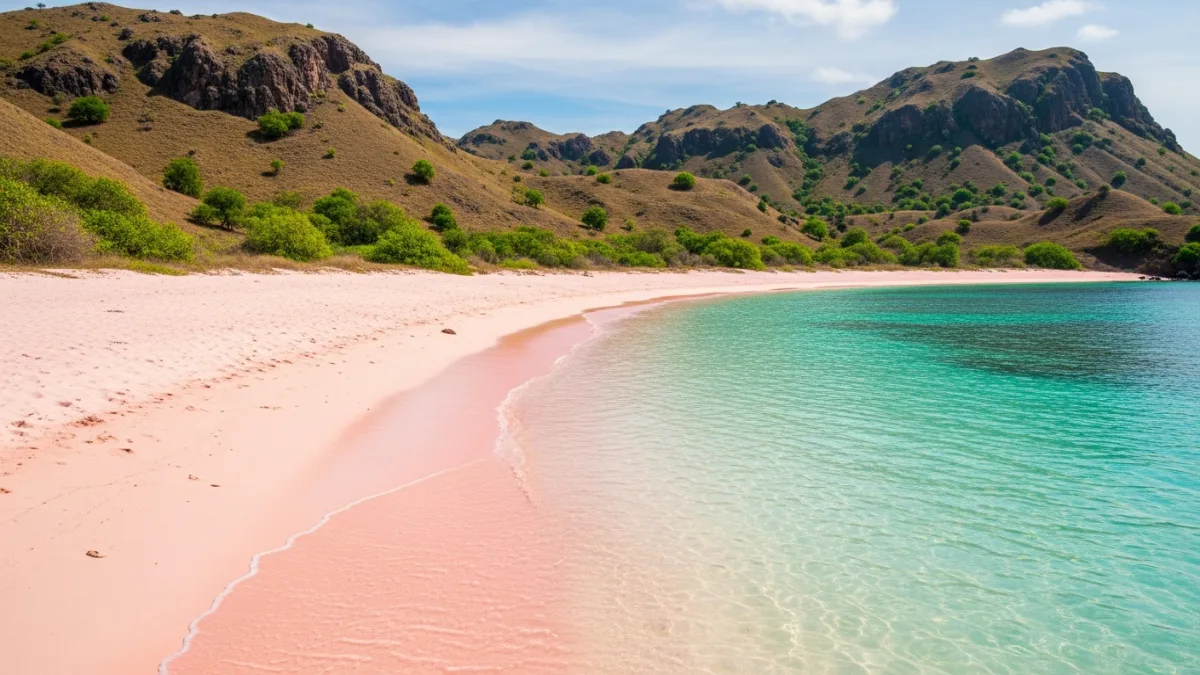
Komodo National Park beaches are the landing points along the park’s islands where boats drop guests ashore for swimming, snorkelling and photography — from the crushed-coral pink sand of Pantai Merah and the long white curve on Padar to the tide-born Taka Makassar sandbar and the dark volcanic shores of Horseshoe Bay in the far south.
Updated July 2026
We have been running boats out of Labuan Bajo since 2015, and beaches are where most of a Komodo day actually happens. Between ranger-guided dragon treks at Loh Liang on Komodo Island and Loh Buaya on Rinca, the hours belong to sand: wading ashore on Kelor before the day boats arrive, snorkelling straight off Kanawa’s reef edge, standing on a sandbar that will be underwater by afternoon. Because we own, crew and maintain our own fleet, we time these stops around tide and light rather than around whoever else is on the water — and we handle the park permits, ranger arrangements and formalities for our guests as part of the booking.
This is the complete reference to every beach you can land on in Komodo National Park, what the sand is actually made of, whether it is worth swimming there, which trips reach it, and what time of day rewards you most.
Every beach in Komodo National Park at a glance
| Beach | Island / area | Sand character | Swimming & snorkelling | Which trips stop there | Best time of day |
|---|---|---|---|---|---|
| Pink Beach (Pantai Merah) | Komodo Island, central zone | Blush pink — white sand mixed with crushed red organ-pipe coral | Excellent; reef starts a few metres out | Full-day speedboat, 2D1N, 3D2N, private charter | Late morning, when high sun deepens the pink |
| Long Beach | Padar Island, central zone | Pale white, long open curve below the viewpoint ridge | Good swimming; open water, best in calm seas | 3D2N and longer; private charter | After the sunrise Padar hike, mid-morning |
| Taka Makassar | Near Manta Point, central zone | Pure white crescent sandbar — appears and disappears with the tide | Shallow, warm, superb clear-water snorkelling | Full-day speedboat, 3D2N, private charter | Around low tide, when the crescent is fully exposed |
| Kanawa Island | Between Labuan Bajo and the park | Soft white, gently shelving | Reef reachable directly from the beach | Full-day speedboat, 2D1N, 3D2N | Early morning or late afternoon |
| Kelor Island | Near Labuan Bajo | White sand strip beneath a steep green hill | Calm, sheltered, easy entry | Full-day speedboat, first or last stop | First stop after departure, around 07:00 |
| Sebayur | Northern zone | White sand fringed by reef | Very good snorkelling off the drop-off | 3D2N, liveaboard, private charter | Mid-morning, before wind builds |
| Mawan | Central zone | Fine white sand on a small, quiet island | Calm shallows; manta rays sometimes pass offshore | 3D2N, private charter | Early afternoon |
| Bidadari | Just outside Labuan Bajo | White sand, closest beach to the harbour | Sheltered swimming and easy reef snorkelling | Half-day add-ons, arrival or departure day | Late afternoon before the run back |
| Horseshoe Bay beaches (Nusa Kode) | Southern zone | Dark, coarse volcanic sand | Cooler water (~22C); dramatic rather than casual swimming | Longer private charters and liveaboards | Early morning, when dragons patrol the shoreline |
| Gili Motang shores | Southern zone | Dry, pale sand backed by parched hills | Viewed and snorkelled from the boat’s tender | 5D4N and longer private charters | Morning, in settled seas |
Why is the sand at Pink Beach actually pink?
Pantai Merah — Pink Beach — sits on the eastern shore of Komodo Island, and the colour is not a trick of the light. Offshore reefs here contain large colonies of red organ-pipe coral. As waves break down old skeletal fragments, millions of red particles wash ashore and mix through the white carbonate sand. The result is a blush that intensifies where the wet sand meets the water line and after the surf has stirred fresh material in.
Practically, that means Pink Beach photographs best in bright, high-angle light, when the wash zone glows. It also means the reef that creates the colour is right there: swim out twenty or thirty metres and you are over healthy coral with reef fish in every direction. Almost every itinerary we run includes it — one day, two, three or twelve.
Which beaches are quietest early in the morning?
Kelor Island and Kanawa are the two that reward an early hull. Our full-day shared speedboat leaves Labuan Bajo around 05:00 to 06:00 and returns around 17:00 to 18:00, which puts the first landing ashore while the light is still low and the sand is unmarked. On a private speedboat charter at USD 800 per boat, you set the order yourself — we routinely run Kelor first for guests who want the beach to themselves.
Padar’s Long Beach is a different kind of quiet. Most people climb the ridge for the famous three-bay view and leave. Coming down to the beach afterwards, while other boats are still on the trail, gives you a wide white curve almost to yourself. Worth knowing: Padar has no Komodo dragons — the population there disappeared, last reported around 1975 — which is simply an interesting piece of island history, not a reason to skip what is one of the greatest sights in the park.
Which beach depends most on the tide?
Taka Makassar, without question. It is not an island but a sandbar near Karang Makassar, where the manta rays gather. At low water it emerges as a perfect white crescent ringed by turquoise shallows; at high water it thins to a sliver or vanishes entirely. There is no trick to it beyond timing, and timing is what an operator is for — our skippers plan the Manta Point and Taka Makassar pairing around the day’s tide so guests get both the rays and the sandbar.
Which beaches reward calm seas?
Open-water beaches feel entirely different in flat conditions. Long Beach on Padar, the northern sands around Sebayur near Gili Lawa Darat and Gili Lawa Laut, and the southern shores at Gili Motang all sit exposed to swell. In settled seas they are effortless landings; in a stiff breeze the tender ride is bouncier and snorkelling visibility drops. Sheltered stops — Kelor, Bidadari, Mawan, Pink Beach’s inner bay — hold up well in almost any conditions, which is why we keep them in the rotation as reliable alternatives.
Which beaches do only the longer voyages reach?
The dark-sand beaches of the southern zone are the park’s genuinely rare landings. Horseshoe Bay at Nusa Kode — also called Gili Dasami — is ringed by coarse volcanic sand and backed by dry hills, with the celebrated dive sites Cannibal Rock and Yellow Wall just offshore. Water here runs cooler, around 22C. It is also one of the few places where guests watch wild Komodo dragons patrolling a beach, moving along the tideline in the early morning.
Nusa Kode and nearby Gili Motang are two of the four islands inside the park where wild dragons live, alongside Komodo Island and Rinca Island. (Wild dragons also live on mainland Flores, outside the park, which is why you sometimes see “five islands” quoted.) Approximate populations: Komodo around 1,700, Rinca around 1,300, Gili Motang under 100, and a small population at Nusa Kode. Gili Motang’s dragons are notably smaller than their northern cousins — roughly a third shorter and much lighter — a fascinating adaptation to a small, dry island with less large prey.
These southern shores sit on our longer private charter and liveaboard routes, from 5D4N upward. If watching dragons on a beach rather than on a trekking path is what you came for, that is the itinerary to ask about.
Safety on shore, near the dragons
Komodo dragons are wild, dangerous animals. You must always stay with your assigned park ranger during any trek and follow their instructions. Never walk ahead of the ranger, keep the distance the ranger sets, do not approach or feed a dragon, and disclose any open wound before the trek. The same discipline applies wherever a dragon appears near a shoreline — stay with the group and let the ranger position you.
What does the park entrance fee cost?
The Komodo National Park entrance tariff for foreign visitors is IDR 250,000 (about USD 16) per person per calendar day, set by Government Regulation PP No. 36 of 2024. It is charged per day rather than per trip, so a multi-day voyage accrues it for each day inside the park. The commonly quoted “IDR 650,000 for 3D2N” is an operator-bundled route ticket, not the state tariff. Small activity add-ons — harbour, snorkelling and diving surcharges — also apply. We confirm the exact current amount with guests at booking and handle payment at the park.
How many days do you need to see the beaches properly?
A full-day shared speedboat at USD 91 per person covers the near-Labuan Bajo beaches plus the central highlights — Kelor, Kanawa, Padar, Pink Beach, Manta Point and Taka Makassar in a single long day. A private speedboat charter is USD 800 per boat for the same range at your own pace.
We recommend 3D2N as the minimum for anyone who wants the beaches unhurried. Our shared 3D2N open trips are priced per cabin from USD 330 to USD 850 per person, from the Yumana Superior at 330 through the Neptune Mansard at 850, with extra beds from USD 250 to USD 410. Whole-boat private charters start at USD 5,300 per night and rise to USD 35,000-plus for VVIP flagships, with a three-night minimum and up to eleven nights available. Booking is 50% deposit with the balance due 14 days before departure.
Tell us which sand you want under your feet and we will build the route around it. Message us on WhatsApp at +62 811 3823 875 or email [email protected], and see our full destination map or go straight to booking your Komodo dragon tour.